Structure Overview
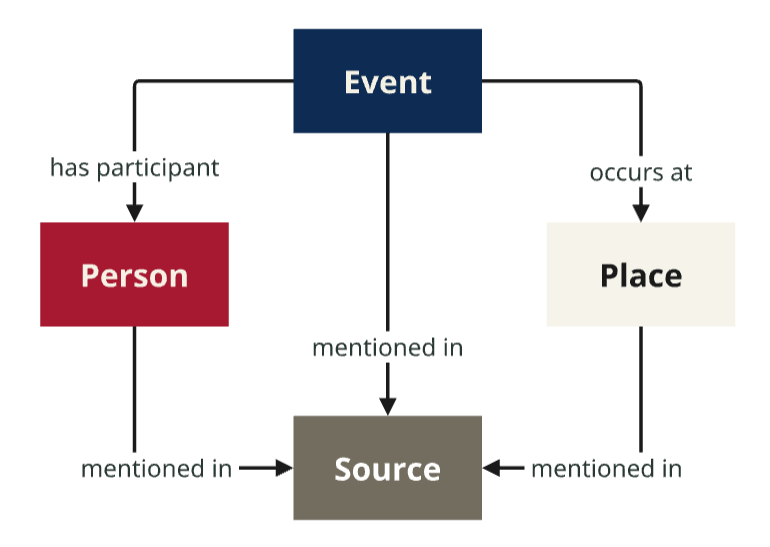
Several types of interconnected records build a dimensional understanding of the community: People, Places, Events, and Sources. Person Records contain biographical and genealogical information alongside timelines that organize every mention of the individual. Event Records reference sources to record what happened, who was involved, and where an event occurred. Source Records guide users to copies of diverse historical material referenced in DASFAM, connecting them with other departmental projects of the Thomas Jefferson Foundation.
Related Projects
DASFAM's metadata and practices are built upon the work of other projects that digitize historic materials and document enslaved communities, including:
Person Records
A Person Record pulls together all information in the database related to that person. As new materials or research are added to DASFAM, records are updated to reflect new information. The main page of a Person Record contains three sections: biographical information, genealogy, and a timeline. Each person has a display name that includes a forename, surname, and life dates. This helps to distinguish people with similar names, especially when little is known about them.
- The biographical section contains basic information about a person and is manually entered by editors. Each statement is supported by a source that is linked whenever possible. Biographical information may include first and last names, nicknames and alternate spellings, gender, birth and death information, and enslavers, who also have their own record. Secondary sources related to that individual and their family, such as books, videos, and encyclopedia articles, can also be linked.
- The genealogy section shows immediate familial relationships: mother, father, partners, and children. A source is provided for each relationship. If these relatives have a person record, it will be linked. This section is also created manually. As part of genealogical research, we occasionally run into cases where individuals may be related, but there is still room for doubt. In such cases, editors will use the terms “Likely” and “Possibly” to indicate certainty. These connections will also used to generate a dynamic Family Tree page.
- The timeline organizes every event that person participated in currently in our database. This section is automatically generated based on metadata from Event Records. This generates a timeline of the person’s life through source materials, with each event linked to the document from which it was pulled.
Event Records
Each Event Record contains information about a single event, who was involved, and points to Source Records that verify this event. To ensure event records remain relevant to DASFAM’s scope, each event must involve someone who was enslaved by Thomas Jefferson (or a descendant). Metadata and contextual information should also center this individual(s) as the main actor or subject of the event. Events in the dataset are unique in Event Type and Subtype, date, and/or location.
- The event information section stores information that is true for all participants of the event. Event Type and Subtype communicates an event’s overarching characteristic or outcome and is a controlled vocabulary. The date of the event, date certainty, a description of what is happening, and links to any Source Records relating to this event are also documented. Connections to sources may also contain notes on how the source was used to document the event.
- Each person relevant to this event is added as a participant, ideally by connecting a person record. Each participant should have a designated role in the event and may have other metadata connected. Participant metadata – as opposed to Person Record metadata – contains attributes of that person that may fluctuate over time, such as their status or occupation.
Source Records
Each source record should include all information necessary to locate that source, including author or creators, recipients, date, scope, type, and repository information. Although DASFAM is founded on historic manuscripts, source content will eventually include multimedia materials such as artifacts, photographs, oral histories, and more.
- Documents draw heavily from the editorial practices of the PTJRS. The transcriptions aim to be as close to the original source material as possible, maintaining unique spellings and grammar of the author and noting significant alterations the author made. While most documents currently in the database are pages of the Farm Book, future content will include letters, wills, inventories, bills, account books, memoirs, interviews, and marriage records.
- Each document provides additional information on where the original item is archived and a link to the scan of the original manuscript if possible. Previous and next pages (or documents) will be linked if part of a collection or set.
Contact Us
Have comments, feedback, or questions about DASFAM? Please use the Contact form located at the bottom of the Getting Word Home page.